Managed Security Services for VAR Growth
Managed security services for VAR help add 24/7 SOC coverage, recurring revenue, and stronger client retention without building security ops in-house.

A VAR can close a firewall deal on Monday and lose the renewal conversation on Friday if the client asks a harder question: who is watching this environment at 2:00 a.m.? That gap is why managed security services for VAR businesses have shifted from a nice add-on to a strategic requirement. Buyers no longer want security products without operational accountability. They want detection, investigation, and response tied to real outcomes.
For value-added resellers, that changes the economics of the relationship. Product margins are pressured. Procurement cycles are competitive. Clients expect ongoing protection, not just implementation. Managed security creates a path to recurring revenue, but only if the service model is credible, always active, and aligned with how a VAR actually sells.
Why managed security services for VAR matter now
The market has moved past point-product conversations. A client may still buy endpoint, email, identity, or cloud controls, but the purchase decision is increasingly shaped by one issue: who operates the stack when alerts fire? Security tools without a live response model often create more noise than assurance.
That puts VARs in a difficult position. Customers trust them to recommend the right technologies, yet modern threats require 24/7 monitoring, triage discipline, investigation workflows, and containment decisions that most reseller organizations were not built to deliver internally. Hiring analysts, running a SOC, maintaining coverage across shifts, and standardizing escalation is expensive. For many VARs, it is not just costly - it is operationally unrealistic.
Managed security services address that problem by attaching a security operations capability to the resale relationship. Done well, the VAR keeps strategic control of the account while adding a service layer that makes the underlying technology more valuable. Done poorly, the VAR becomes a pass-through with little differentiation and even less visibility.
The business case is stronger than the product case
Security services are often discussed as a technical extension, but for a VAR, the commercial impact is just as important. Recurring revenue is more stable than one-time project revenue. Retention improves when the provider is part of daily protection rather than a periodic procurement event. Account expansion also becomes easier because the conversation shifts from hardware and licenses to risk, coverage, and response readiness.
There is another advantage that matters in competitive sales cycles. A VAR offering managed detection and response, SOC-backed monitoring, and guided incident handling can compete at a higher level than a reseller that only quotes tools. That does not mean every account needs the same package. Some buyers want support around tools they already own. Others want a fully delivered security stack with operations included. The service model has to support both.
This is where many channel programs fall short. They give partners products and pricing, but not a real operating model. Managed security services for VAR organizations only create lasting value when the service can be sold consistently, delivered continuously, and presented under a partner-friendly structure.
What VARs should evaluate in a managed security partner
The first requirement is 24/7 execution. Not messaging, not a daytime help desk, and not alert forwarding disguised as MDR. If a partner cannot show how threats are detected, investigated, and acted on around the clock, the service will fail under pressure. Clients do not measure security by dashboard aesthetics. They measure it by response when something is wrong.
The second requirement is flexibility in delivery. Some VARs have customers with mature toolsets already deployed. In those cases, the right model supports customer-owned technology while adding SOC expertise and response discipline. Other clients want a consolidated service that includes the stack and the operations layer together. A provider that can support both motions gives the VAR more room to sell into mixed environments.
White-label or co-branded support is also significant. For many VARs, brand ownership matters. They want to deepen client relationships without introducing channel conflict or teaching the customer to bypass them. A partner-first approach — backed by a written commitment never to compete for the partner's clients — protects that relationship and turns the security provider into an operational engine behind the scenes rather than a competitor in front of the account.
Finally, the economics have to work. A service may be technically strong and still be commercially weak if pricing leaves no room for margin, packaging is too complex, or onboarding is too heavy for midmarket accounts. The best partner models are designed for scale. They make it possible for the VAR to quote, launch, and support managed security without custom engineering every deal.
Where managed security services for VAR deals usually break down
The biggest failure point is overpromising. A VAR sells "SOC" when what the customer receives is alert routing and a vague escalation matrix. That mismatch damages trust quickly. Security services need clear boundaries: what is monitored, what is investigated, what actions are taken, and where responsibility changes hands.
Another common issue is tool-first selling. If the provider relationship revolves around a specific platform rather than an operating outcome, the VAR may struggle in accounts where the client already has established investments. Buyers do not want to rip and replace just to gain monitoring. In many environments, the stronger approach is to support what exists and improve the detection and response function around it.
There is also a maturity gap to consider. Not every VAR is ready to sell full-spectrum managed detection and response on day one. Some need a partner that helps shape the offering, supports sales engineering, and provides a service architecture that is easy to position to SMB and midmarket buyers. If onboarding the partner is harder than selling the service, adoption will stall.
A practical operating model for VAR growth
For most VARs, the strongest path is not building an internal SOC from scratch. It is adding an outsourced security operations layer that can be packaged under the VAR's go-to-market model. That gives the business a way to expand beyond project revenue while protecting internal resources.
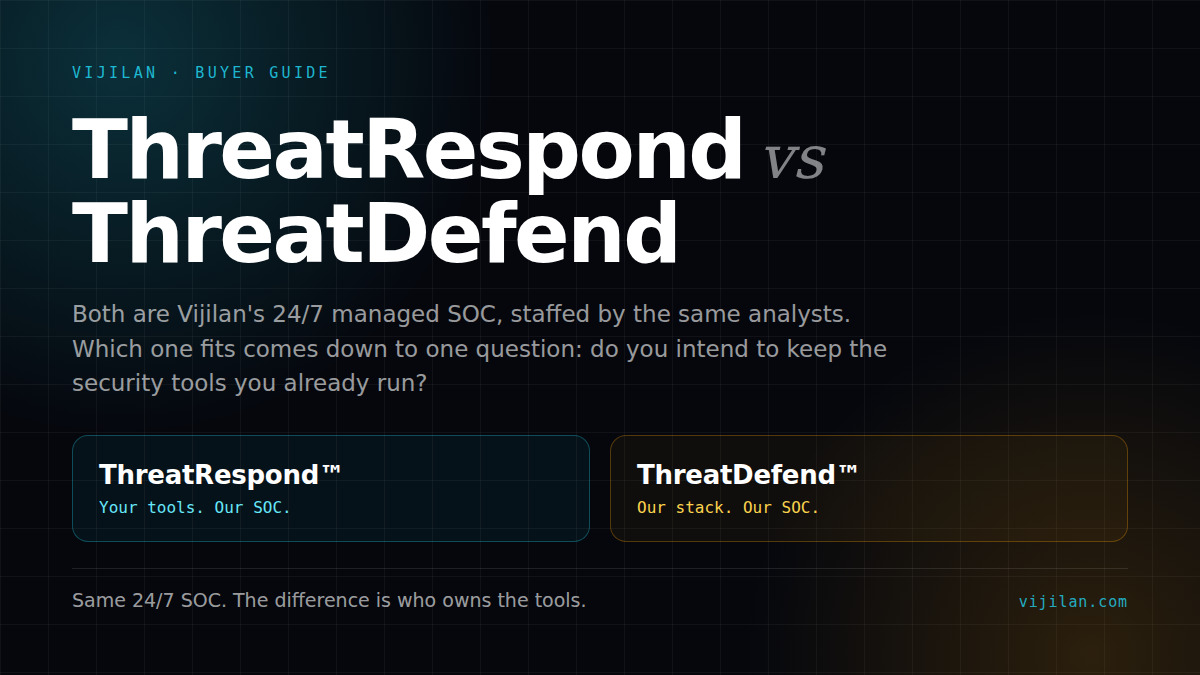
In practice, this often means choosing between two service motions. One model supports the customer's existing security tools and layers on live SOC expertise for continuous monitoring, threat investigation, and response. The other bundles the security stack with the operations function so the client gets a more standardized service with fewer moving parts. Both can work. The right fit depends on how standardized the VAR's customer base is, how much tool diversity exists across accounts, and how fast the business wants to scale.
A mature partner should help with that decision. For example, Vijilan structures this in two clear ways: one path for organizations that want SOC support around customer-owned tools, and another for those that want the stack and the SOC delivered together. That kind of clarity matters because it reduces friction in both sales and service delivery.
What buyers expect from the VAR once security becomes recurring
Selling managed security changes the client expectation. The VAR is no longer just the team that recommends and installs technology. It becomes part of the customer's defense posture. That raises the standard for communication, escalation, and accountability.
Clients expect faster answers during incidents. They expect evidence that alerts are being validated and acted on. They expect the provider to understand business impact, not just technical severity. This is why a real SOC-backed service is different from a monitoring add-on. It creates operational substance behind the promise.
For VARs, that is a positive shift if the backend partner is strong. It increases strategic relevance with the client and creates more frequent touchpoints tied to measurable value. But it also means the provider behind the service must be disciplined. Weak triage, slow escalation, or inconsistent case handling becomes visible very quickly.
The channel advantage comes from control, not ownership
Some VARs hesitate because they assume service expansion requires owning every part of the delivery model. It does not. In security, control matters more than internal ownership. If the VAR controls the customer relationship, the service packaging, and the account strategy, a channel-aligned SOC partner can provide the operational depth without diluting the VAR's position.
That is the real appeal of managed security services for VAR organizations. They allow a reseller to step into a more strategic role without taking on the fixed cost and complexity of building a 24/7 security operation alone. The result is better client retention, stronger recurring revenue, and a service portfolio that reflects where the market is headed.
The opportunity is not in adding one more SKU. It is in becoming the provider clients rely on when the alert is real, the clock is moving, and action cannot wait.
Threat notes, once a week
What our SOC actually saw this week: new attack patterns, the detections we shipped against them, and what it means if you run an MSP. Written by the analysts, not by marketing.
See what 24/7 looks like when the SOC actually acts.
Book a 20-minute platform walkthrough: no slide deck, just the console.
Book a walkthrough →