NetDocuments monitoring your stack misses.
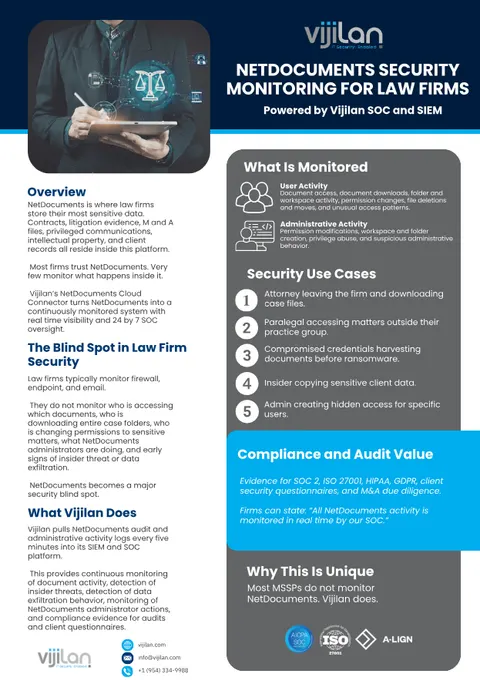
Law firms invest heavily in perimeter security, endpoint protection and email filtering. Yet the system that holds their most sensitive information, NetDocuments, is rarely monitored by a SOC. Vijilan closes this critical visibility gap with real-time monitoring, detection and 24/7 response.
NetDocuments operates outside your existing security stack.
Without dedicated monitoring, your firm has a dangerous blind spot, and you can't prove ABA Rule 1.6 compliance without a credible audit trail.
Firewalls can't see it
Firewalls monitor network traffic but cannot see document-level access, downloads or user behavior within cloud-based DMS platforms.
EDR doesn't understand matters
Endpoint detection monitors device activity but has zero visibility into matter-level access patterns or document repository behavior.
Email security is blind
Email protection secures your inbox but does not monitor document management systems or internal file movements and sharing.
Insider threats go undetected
Departing employees downloading client files, contractors accessing restricted matters: all invisible without DMS-specific monitoring.
Credential compromise
Phished credentials used to access NetDocuments at 2 AM from a foreign IP. Without monitoring, you won't know until it's too late.
Compliance gaps
ABA Rule 1.6 requires "reasonable efforts" to protect client data. How do you prove compliance without monitoring your DMS?
Complete NetDocuments visibility.
We ingest NetDocuments audit logs every 5 minutes into our SIEM platform. Our 24/7 SOC monitors this telemetry continuously and produces ABA Rule 1.6 audit trail for every access event.
Continuous DMS audit
Every document access, version change, share grant, download and matter-level permission shift is captured and correlated in ThreatLog SIEM.
Behavioral baselining
60-day baseline establishes normal access patterns per user, per matter, per practice group. Anomalies surface immediately.
ABA 1.6 audit-ready
Every event is timestamped, signed and retained for 7 years. Pull the audit pack for any matter in seconds: partner, paralegal, opposing counsel, expert witness.
What we catch every day.
Network monitoring for a law firm means continuously watching the firm's network traffic and the systems on it, firewalls, VPN, authentication, endpoints and outbound connections, with a SOC investigating what looks wrong rather than filing an alert.
It is necessary and it is not sufficient. Network telemetry can show that a session authenticated and that data moved. It cannot show which matter was opened or whose client file it was. That answer lives in the document management system, which is the one place most firms never monitor.
Network monitoring for law firms, and where it stops.
What does network monitoring for a law firm cover?
It watches the traffic moving across the firm network and the systems attached to it: firewall and VPN activity, authentication attempts, endpoints, servers, and connections leaving the network. A SOC collects that telemetry continuously, correlates it, and investigates what looks wrong. For a law firm the point is not only intrusion but confidentiality, because an unusual outbound transfer at 2am is a client-file question before it is a technical one.
Is network monitoring enough on its own for a law firm?
No, and this is the gap we see most often. Network monitoring can tell you a session was authenticated and a volume of data moved. It cannot tell you which matter was opened, who the client was, or whether the person browsing had any business being in that folder. That lives in the document management system, and most firms monitor everything except the system holding their most sensitive material.
Do we have to replace our firewall or endpoint tools?
No. We wrap a 24/7 SOC around what the firm already runs and add the sources nobody is watching, typically the document management system. Where a replacement is genuinely the better answer we will say so, but that is a conclusion from an assessment rather than a condition of working together.
How does this help with ABA Rule 1.6?
Rule 1.6(c) requires reasonable efforts to prevent unauthorized disclosure of client information. Reasonable efforts are easier to demonstrate than to assert: continuous monitoring produces a timestamped record of who accessed what and when, so the firm can answer the question for a specific matter rather than describing its policy.
Does a small firm need this, or is it only for large firms?
Firm size changes the volume, not the exposure. A twelve-person practice handling litigation holds material that is just as sensitive as a national firm holds, usually with nobody whose job is security. That is the case we are generally built for.
Free NetDocuments security assessment.
Schedule a consultation with our legal industry security experts. We'll assess your NetDocuments environment and show you exactly what we can monitor.
- Free assessment, no obligation
- Deploy in under 60 minutes, zero operational impact
- 24/7 SOC monitoring starts immediately
- SOC 2 Type II and ISO 27001 certified
"Having those capabilities integrated into a single platform has simplified operations, improved our security posture, and allowed us to focus on strategic initiatives rather than day-to-day monitoring and management."
The ABA compliance guide and NetDocuments monitoring brief, built for legal practices.