Technology Solution Providers.
The channel's broadest partners.
TSPs sell every layer of the stack — and their clients now expect the security layer to come with 24/7 eyes. Here is what a Technology Solution Provider is, why the category is racing into managed security, and how to add a white-label SOC without hiring a single analyst.
A Technology Solution Provider (TSP) is a channel company that designs, sources and manages a client's technology end to end — hardware, software, cloud, licensing and services — as a single accountable partner. TSPs increasingly partner with white-label SOC providers like Vijilan Security to add 24/7 managed security, because staffing one around-the-clock analyst seat takes 8–12 full-time hires.
What a TSP actually is,
and what it isn't.
A Technology Solution Provider bundles what used to be four separate vendors into one relationship: the reseller that sources hardware and licensing, the integrator that makes it work together, the consultant that maps it to the business, and the managed-services team that runs it day to day. CompTIA's channel standards treat "solution provider" as exactly this kind of umbrella — applying to channel firms "whether operating as a traditional VAR, managed services provider, or a hybrid," because in practice most are hybrids. The through-line is accountability: one partner, one bill, one throat to choke.
The acronym deserves one disambiguation, because it collides with two neighbors. Gartner's "TSP" means "technology and service providers" — its term for the vendor side of the industry, not the channel. And ChannelE2E coined "Total Services Provider" for the rare firm that ranks among the top VARs, MSPs and cloud providers simultaneously. On this page — and in most channel usage — TSP means the partner-side category: the Technology Solution Provider.
Scale is not what defines the category. The model runs from $22 billion national giants to 30-person regional firms, and the comparison below is what separates it from the neighboring channel models.
TSP vs. MSP vs. MSSP vs. VAR. One table.
| Model | One-line definition | Typical revenue model |
|---|---|---|
| TSP — Technology Solution Provider | A single accountable partner that designs, sources and manages a client's entire technology stack — hardware, software, cloud, licensing and services — with a business-transformation focus. | Blended: recurring managed-services contracts + product resale margin + project and consulting fees |
| MSP — Managed Service Provider | Delivers network, application, infrastructure and security services via ongoing, regular support and active administration (Gartner's definition). | Recurring subscription, typically per user or per device monthly |
| MSSP — Managed Security Service Provider | Provides outsourced monitoring and management of security systems from high-availability security operation centers, 24/7 (Gartner's definition). | Recurring security-service subscription: SOC, MDR and SIEM-as-a-service tiers |
| VAR — Value-Added Reseller | Buys vendor products at a discount, adds presales engineering, proof-of-concept and integration value, and resells at a markup (Gartner's definition). | Transactional: product resale margin plus implementation and support fees |
// MSP, MSSP and VAR definitions per the Gartner IT Glossary · models overlap in practice — most channel firms are hybrids
From national giants
to regional specialists.
The TSP model works at every size. What changes with scale is who feels the security-talent gap hardest — and it isn't the giants.
Multi-brand IT solutions provider serving 250,000+ business, government, education and healthcare customers.
Fortune 500 "solutions integrator" spanning cloud, data, AI, cybersecurity and device services.
Self-described "transformational technology solutions provider" — and the largest MWBE in the U.S.
"Global technology solutions provider" known for its Advanced Technology Center lab ecosystem.
Digital services and solutions provider with deep networking, cloud and security integration expertise.
"Leading information technology solutions provider" to business, government, healthcare and education.
Services-led solutions in AI, security, cloud and networking — 15 consecutive years on CRN's Solution Provider 500.
Companies referenced are examples of the Technology Solution Provider category and are not implied to be Vijilan partners or customers. Scale figures reflect public filings and company statements at the time of research; CRN's Solution Provider 500 is the category's reference ranking.
Women-owned provider of IT solutions and services for Fortune 1000 companies; 2026 CRN Solution Provider 500 honoree.
Infrastructure, edge-to-cloud and cybersecurity solutions; a CRN "Triple Crown" winner (SP500, Tech Elite 250, MSP 500).
Technology and cybersecurity solutions and consulting for mid-market and enterprise; climbed 37 spots on the 2025 SP500.
Secure device lifecycle, endpoint and data protection — No. 193 on CRN's 2025 Solution Provider 500.
Northeast solutions firm founded 1979; ten consecutive years on CRN's Solution Provider 500.
The giants can hire a security bench. A 50-person regional TSP competing against a 4.8-million-person global talent gap cannot — which is exactly where the white-label SOC model earns its keep.
Companies referenced are examples of the Technology Solution Provider category and are not implied to be Vijilan partners or customers.
Why TSPs are adding managed security
right now.
Client demand, compliance deadlines, recurring revenue and the impossibility of staffing a 24/7 SOC economically — each with the number behind it.
Canalys projects that over 90% of the $281 billion spent on cybersecurity in 2025 involves channel partners. Security is a channel business — and clients expect their solution provider to own it.
Source: Canalys, Cybersecurity Leadership Matrix 2025 ↗Up 14 points year over year — and nearly half of SMBs say they would switch providers for more robust cybersecurity. The retention risk of not offering 24/7 security is now larger than the cost of adding it.
Source: ConnectWise / Vanson Bourne, State of SMB Cybersecurity 2025 ↗The ISC2 Cybersecurity Workforce Study put the global talent gap at 4.8 million professionals in 2024, with 90% of organizations reporting skills shortages. Hiring a security bench is hardest for the regional firms that need it most.
Source: ISC2 Cybersecurity Workforce Study, 2024 ↗Sophos' Active Adversary Report found 88.1% of ransomware payloads were deployed during non-business hours. Nine-to-five coverage is structurally insufficient — the attack lands when your team is asleep.
Source: Sophos Active Adversary Report 2026 ↗The Ponemon Institute puts the average annual cost of running an in-house security operations center at $2.86 million — and keeping one 24/7 seat staffed takes 8–12 full-time analysts before tooling. The build-it-yourself math does not close for most solution providers.
Source: Ponemon Institute, The Economics of Security Operations Centers ↗The 48 CFR acquisition rule took effect November 10, 2025: CMMC clauses now appear in new DoD solicitations with no grace period. Add cyber-insurance carriers crediting MDR — insurer At-Bay found more than half of claims could have been mitigated by effective MDR — and compliance demand is pulling every client conversation toward managed security.
Source: PKF O'Connor Davies on 48 CFR; At-Bay claims analysis ↗The summary is arithmetic: security demand is concentrated in the channel, clients will switch providers to get it, the talent to build it in-house does not exist at market salaries, and the attacks land at 3 AM. For a Technology Solution Provider, managed security is no longer an adjacent product line — it is the retention layer under every other line on the invoice.
How Vijilan powers TSPs.
White-label. Partner-first. Never competing.
Vijilan Security never competes with its partners for their clients — MSPs, MSSPs, VARs and TSPs keep their accounts. Your brand stays on the service; Praxis, Vijilan's AI/SOC engine, and a 24/7 Global SOC do the work behind it.
Partners get protected too: the Vijilan Guard NFR program covers the partner's own environment, so the firm selling 24/7 security actually has it. Everything is delivered under your white-label brand, with the partner program handling enablement, and a standing commitment never to compete with a partner for their client — Vijilan has no motion to compete with yours.
Technology Solution Providers, answered.
What does TSP stand for in IT?+
In the IT channel, TSP stands for Technology Solution Provider: a company that designs, sources and manages business technology — hardware, software, cloud, licensing and services — as a single accountable partner. Note the acronym collides with unrelated terms (Gartner uses "technology and service providers" for vendors; ChannelE2E coined "Total Services Provider"), so context matters.
Is a TSP the same as an MSP?+
No, though the models overlap and many firms blend both. An MSP operates and administers IT on an ongoing subscription. A Technology Solution Provider is broader: it consolidates resale, integration, consulting and managed services under one relationship, with a transformation focus rather than a purely operational one. Industry bodies like CompTIA treat "solution provider" as the umbrella covering VARs, MSPs and hybrids.
How do TSPs make money?+
Technology Solution Providers blend three revenue streams: recurring managed-services contracts, margin on hardware/software/cloud resale, and project or consulting fees. The strategic shift across the channel is toward recurring services — and managed security is the fastest-growing recurring line, with managed security services growing more than 15% year over year per Canalys.
Do TSPs need their own SOC?+
TSPs need SOC outcomes — 24/7 monitoring, detection and response — but rarely their own SOC. Keeping one 24/7 analyst seat staffed takes 8–12 full-timers, and Ponemon puts the average in-house SOC at $2.86M per year. Most solution providers deliver the outcome through a white-label SOC partner instead, keeping the client relationship and the margin without the payroll.
What is white-label SOC-as-a-service?+
White-label SOC-as-a-service is a 24/7 security operations center a provider resells under its own brand. The SOC partner supplies analysts, platform and response; the TSP or VAR owns the client relationship, branding and pricing. Vijilan Security delivers this model fully white-label — the end customer sees the partner's brand, not Vijilan's.
How do I know a security vendor will not compete with me for my client?+
Ask for the commitment in writing, and ask what happens to an end-customer enquiry that arrives about an account you already own. The answer you want is that it comes straight back to you. That is the biggest fear in white-label partnerships — the vendor’s sales team calling your client. Vijilan never competes with its partners for their clients; end-customer enquiries are routed back to partners.
What is the difference between a VAR and a TSP?+
A value-added reseller sells products with engineering and integration around them, and earns on resale margin plus project fees. A Technology Solution Provider is broader: it wraps resale, consulting and ongoing managed services into one accountable relationship, so more of the revenue recurs. Most VARs that have added managed services are already operating as TSPs whether or not they use the word, and the security line is usually the first recurring service they attach.
Can a VAR resell managed security without becoming an MSSP?+
Yes, and it is the common path. You keep the client relationship and the paper; Vijilan runs the SOC behind your brand. There is no requirement to build a security operations centre, hire analysts or carry a 24/7 rota, and we never compete with our partners for their clients. Adding the service does not oblige you to change what you already are.
How can a VAR or TSP add 24/7 security without hiring analysts?+
Partner with a white-label SOC. The client keeps their existing tools (a vendor-agnostic service like ThreatRespond wraps the EDR they already run), the SOC partner supplies 24/7 monitoring and active containment under your brand, and your team stays project-focused. Onboarding is measured in days per tenant — not the year-plus it takes to build a security practice.
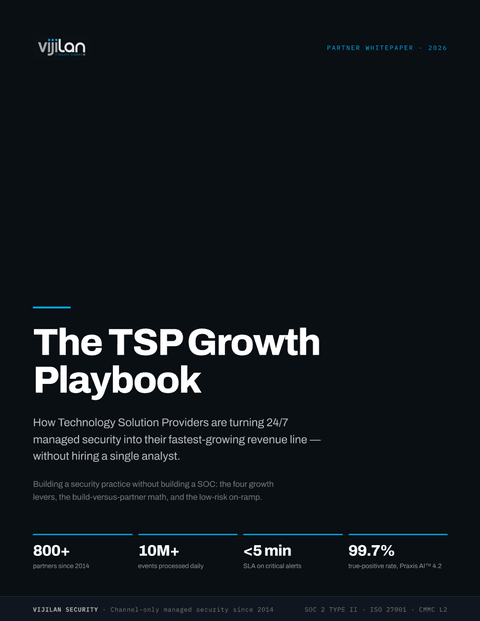
The TSP Growth Playbook. Take it with you.
The full playbook behind this page: the four growth levers TSPs are using to turn 24/7 managed security into their fastest-growing revenue line, the build-versus-partner math, and the low-risk on-ramp — in an eight-page PDF built for forwarding to the rest of your leadership team.
You sold Falcon.
Now sell what happens after it.
The license closes and the client owns a platform. What they do not own is the engineering to onboard their log sources, detections tuned to their estate, or anybody awake at three in the morning to act on what fires. That gap is recurring revenue, and it is the part most resellers hand back or leave on the table.
Deploy
Onboarding, data sources, parsers, dashboards and the first detection set, engineered against the estate the client actually has rather than a reference architecture. This is the work that decides whether the platform produces signal or noise for the next three years.
Sustain
Detection tuning, content updates, parser maintenance and health checks as the estate changes. A SIEM is not a project with an end date, and this is the part that quietly decays when nobody owns it.
Operate
A 24/7 SOC on the other end of it. Analysts investigate what fires and contain what is real, so what you sold produces outcomes rather than a queue somebody is supposed to read.
That is how NextDefend™ is delivered: CrowdStrike Falcon Next-Gen SIEM, engineered and then run by our SOC rather than handed over as a console. Vijilan holds the CrowdStrike Powered Service Provider (CPSP) designation, which is a standing in CrowdStrike’s partner program rather than an audit, and it is what lets us license, deploy and operate Falcon on a partner’s behalf instead of sending the client elsewhere.
The shape of the revenue is the point. Resale is transactional and renews once a year. The deployment, the tuning and the SOC hours are monthly, they are stickier than the license they sit on, and they are the reason the client calls you first when something happens. You keep the relationship throughout: we never compete with our partners for their clients.
"Vijilan's stability and innovation give us the confidence to grow alongside them. They're more than a vendor—they're a true partner."
Put three assessments on the table.
Choose up to three security assessments, run on CrowdStrike Falcon by our engineers across sixty days, at no cost to you or your client. It is the cleanest way to open a security conversation with evidence instead of a deck.
Add the SOC to your line card
without adding the payroll.
Twenty minutes with a partner specialist: we'll map your client base to the right white-label service mix and show you the console — no slide deck, no pressure, and never a competing quote.
Attach to the quote
You can quote Falcon Guardian. Now quote who runs it.
Guardian licenses close faster when the customer can see who operates them. Attach a AgentDefend scope to the quote, with Deploy for onboarding, Sustain for tuning and Operate for the 24/7 SOC, and the conversation moves from “another module” to “handled”. We’re a CrowdStrike Powered Service Provider, we white-label or co-deliver, and the account stays yours.
Book a joint scoping call