MDR for Small Business: What Actually Matters
MDR for small business gives 24/7 threat detection and response without building a SOC. Learn what to look for, what to avoid, and why it matters.

A ransomware alert at 2:13 a.m. does not care that your IT team starts at 8. That is the real reason mdr for small business has moved from a nice-to-have service to an operational requirement. Small organizations are running cloud apps, remote endpoints, identity platforms, and line-of-business systems that face the same attack patterns as larger enterprises, but without the same depth of security staff.
That gap is where many security programs fail. Tools generate noise, alerts sit unreviewed, and response decisions get delayed until business hours. For a small business, the issue is rarely whether security technology exists. The issue is whether someone is actively watching, investigating, and prepared to act when something suspicious turns into something real.
What MDR for Small Business Really Means
MDR for small business is not just outsourced alert monitoring. At a serious operational level, it is a managed service that combines telemetry, threat detection, analyst investigation, and response action through a 24/7 security operations model.
That distinction matters because many small businesses already own some security tools. They may have endpoint protection, email security, firewalls, or Microsoft security features. What they often do not have is continuous correlation across those layers, human-led triage, and clear response execution when an attacker moves from initial access to lateral movement or data theft.
A credible MDR service closes that gap. It ingests signals from the environment, applies analytics and threat intelligence, validates what is malicious, and initiates containment or escalation based on agreed procedures. The value is not the dashboard. The value is disciplined action under pressure.
Why Small Businesses Are Turning to MDR
Most small and midsize organizations do not need a full in-house SOC. They need SOC outcomes. There is a big difference.
Building internal coverage means staffing for nights, weekends, vacations, turnover, and specialized investigation skills. Even a modest security operations function becomes expensive fast. You are not only paying for headcount. You are paying for process maturity, tool tuning, case management, threat intelligence, and response coordination.
MDR gives small businesses a way to buy the function rather than build the department. That is especially relevant for MSPs and IT providers serving SMB clients. Their customers want enterprise-grade protection, but they do not want enterprise-grade overhead. A managed cybersecurity company can bridge that requirement with a service model that is always on, technically mature, and commercially easier to deliver.
The pressure is also coming from the threat side. Identity attacks, business email compromise, endpoint compromise, and hands-on-keyboard intrusion are no longer reserved for large targets. Small businesses are often easier to reach because controls are less mature and response workflows are less formal.
What Good MDR Looks Like in Practice
A strong MDR service should do more than send tickets. It should reduce decision time when risk is real.
At minimum, that means 24/7 monitoring, analyst-backed investigation, and defined response workflows. It should also mean that detections are mapped to actual attacker behavior, not just product events. If a user account begins showing impossible travel, privilege changes, and suspicious authentication patterns, the provider should be able to connect those dots quickly and determine whether containment is required.
The best providers also understand that environments differ. Some small businesses want support around tools they already own. Others want a fully managed stack paired with live SOC coverage. Both approaches can work, but they solve different operational problems.
If the customer already has security technology they trust, a service aligned to that existing stack may be the better fit. If the environment is fragmented or underpowered, a bundled model that includes both the platform and the monitoring team can create better consistency. The right answer depends on tool maturity, internal IT bandwidth, and how much standardization the business wants.
MDR for Small Business Is Not the Same as EDR
This is one of the most common buying mistakes.
EDR focuses on endpoint telemetry and detection at the device level. It is an important control, but on its own it does not provide a complete operating model. Someone still needs to review alerts, investigate context, determine scope, and respond.
MDR builds on detection technologies and adds the service layer. That layer includes analysts, escalation logic, case handling, and response procedures. In other words, EDR is a tool category. MDR is an operating capability.
For small businesses, this difference is critical. Buying a strong endpoint product without active management often creates a false sense of security. The logs may exist. The alerts may fire. But if nobody is driving the process, risk can still escalate unchecked.
What to Evaluate Before You Buy
The first question is not price. It is coverage.
Ask what data sources the provider monitors and how broadly detections are correlated. If the service only looks at endpoints, blind spots remain in identity, cloud applications, network activity, and email. Not every small business needs every telemetry source on day one, but the provider should have a clear architecture for expanding visibility as the environment evolves.
Next, examine response authority. Some MDR providers stop at notification. Others can isolate hosts, disable accounts, kill processes, or guide remediation in real time. That difference has a direct effect on dwell time and blast radius. If a provider says they offer response, ask what actions they can actually take, under what conditions, and at what speed.
Then look at operating discipline. Is the SOC truly staffed 24/7, or is overnight coverage more limited than it appears? Are alerts triaged by analysts or routed through automation with minimal validation? Automation matters, especially for scale, but small businesses still need human judgment when incidents become ambiguous or high impact.
Reporting is also worth scrutinizing. Good MDR reporting should show not only volumes and alerts, but investigation quality, response timelines, attack trends, and meaningful recommendations. If reports are full of activity but light on conclusions, they are not helping the customer make better decisions.
Trade-Offs Small Businesses Should Expect
There is no perfect MDR model for every organization. There are trade-offs.
A lower-cost service may provide basic monitoring but limited response depth. That can be enough for a business with strong internal IT and well-defined escalation paths. It is less effective for a lean team that needs a provider to carry more of the operational load.
A bundled security stack can simplify deployment and improve consistency, but it may reduce flexibility if the customer is attached to existing tools. On the other hand, keeping the current stack may preserve prior investments while creating integration complexity that weakens visibility.
Small businesses should also be realistic about onboarding. Good MDR is not magic that appears in one day. The provider needs time to tune detections, define response procedures, understand the environment, and align with business priorities. A fast start matters, but maturity matters more.
Why Channel Delivery Matters
For MSPs, MSSPs, and VARs, mdr for small business is not only a protective service. It is a growth lever.
Clients increasingly expect security operations support as part of managed IT. Yet building a true SOC internally is expensive, hard to staff, and difficult to scale across a diverse customer base. A white-labeled or channel-aligned MDR model allows providers to offer enterprise-grade security outcomes without standing up their own 24/7 operation.
That matters commercially and operationally. The provider can expand recurring revenue, increase account stickiness, and strengthen trust with customers, while relying on a security partner for the constant monitoring and incident pressure that most IT teams are not built to absorb. This is where a managed cybersecurity company with a live SOC and flexible delivery model becomes more than a vendor. It becomes part of the service architecture.
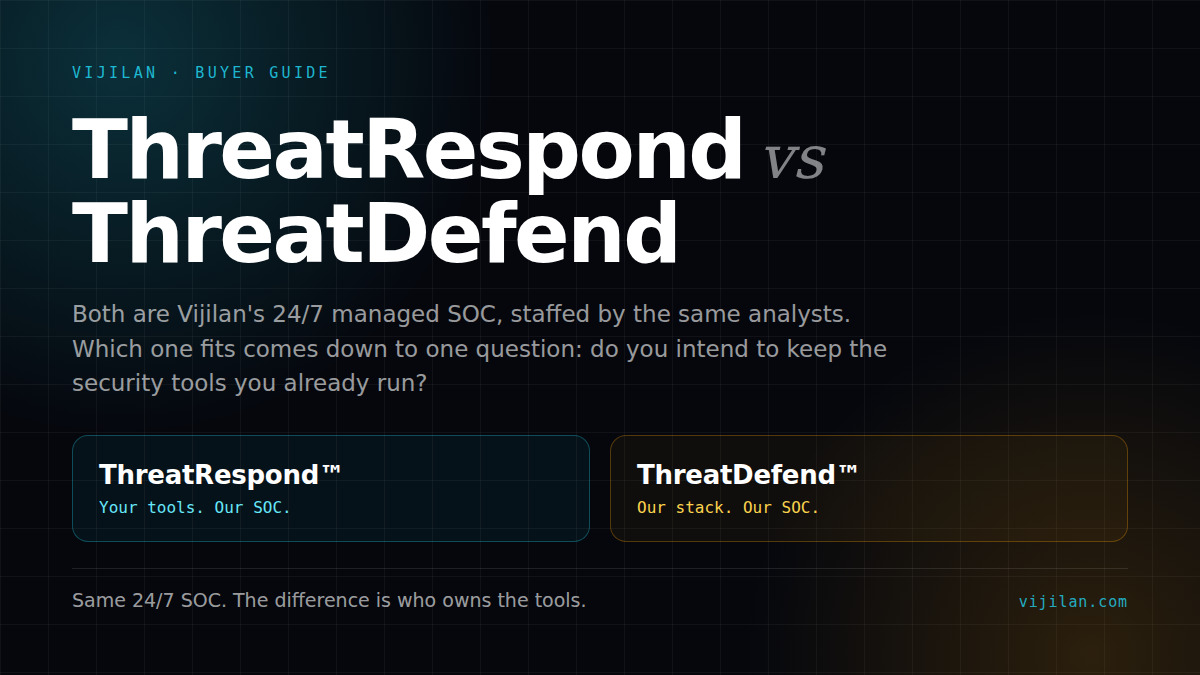
Vijilan’s model reflects that reality by supporting both customer-owned toolsets and fully managed security platforms, giving partners and SMBs options based on how they want to operate.
The Right Standard Is Simple
When evaluating MDR for small business, the standard should be straightforward: if something serious happens at 2:13 a.m., who sees it, who understands it, and who acts?
Everything else is secondary. Features matter. Integrations matter. Commercial terms matter. But small businesses are not buying security theater. They are buying response capacity, investigative depth, and the confidence that someone is actively defending the environment when internal teams are offline.
That is the benchmark worth holding. If your current security stack cannot answer that after-hours question with certainty, the next step is already clear.
Threat notes, once a week
What our SOC actually saw this week: new attack patterns, the detections we shipped against them, and what it means if you run an MSP. Written by the analysts, not by marketing.
See what 24/7 looks like when the SOC actually acts.
Book a 20-minute platform walkthrough: no slide deck, just the console.
Book a walkthrough →