Finishing the Map: Why CrowdStrike and Zscaler Make Sense
Reports say CrowdStrike is in talks to acquire Zscaler. Here is why the logic holds, why every move before it was right, and what it means for the teams who run security every day.
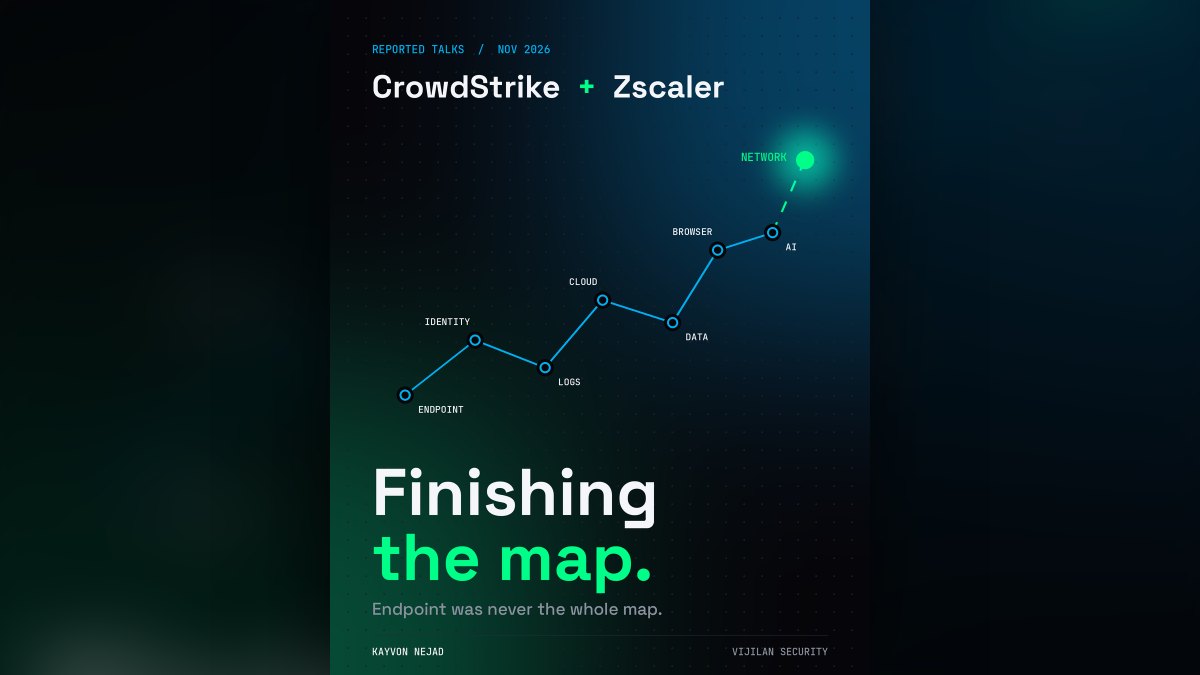
On November 20, Bloomberg and Reuters reported that CrowdStrike is in talks to acquire Zscaler [1][2]. Nothing is signed. Reuters' sources were clear that no deal is guaranteed and the talks could still end without an agreement.
So this is not a news story. It is a read on strategy, from a team that builds on the CrowdStrike Falcon platform every day.
Our read is simple. If it happens, this is the most logical deal in cybersecurity.
Think about how an attacker moves
Attackers do not care about your org chart. They do not care which vendor owns which layer of your stack.
They move from a laptop, to an identity, to the network, to a cloud application. To them, it is one path.
For a decade, the industry sold security in pieces. Endpoint from one vendor. Identity from another. Network from a third. Logs somewhere else. Every boundary between those tools became a seam, and seams are where attackers hide. Security teams were left stitching the pieces together by hand, often at 2am, in the middle of an incident.
The answer the market has settled on is the platform: one place that sees the whole path.
Why Zscaler
An attack path has two halves: what happens on the device, and what moves between devices.
CrowdStrike already owns the first half. Zscaler sits in the middle of the second, in the path of the traffic itself.
The groundwork is already in place. In September 2026, the two companies expanded their strategic partnership [3]. Under that plan, Falcon continuously assesses user risk and passes that context to Zscaler, which can tighten access automatically when an endpoint behaves suspiciously. The companies also announced a native Falcon Foundry application built on Zscaler's platform, and network and AI-event logs flowing into Falcon Next-Gen SIEM. Those integrations were announced as in development.
In other words, the sensor is being wired to the gate. An acquisition would remove the wall between them.
It also answers the competition directly. Palo Alto Networks has spent years building a platform that spans network, cloud and the SOC, and closed its acquisition of CyberArk in February 2026 [4]. Adding Zscaler would give CrowdStrike the network and access layer it has been missing and put it head to head across the full stack.
Why every move before it was right
The Zscaler logic is not new. It is the latest step in a pattern CrowdStrike has followed for years. Each acquisition answered a question an attacker forces a defender to ask.
- Who is this, really? Preempt (2020) brought identity protection onto the platform, early, before identity was widely called the new perimeter.
- Where is the evidence? Humio (2021) brought high-speed log ingestion for first- and third-party data, the foundation for what became Falcon Next-Gen SIEM [5].
- What is this application doing? Bionic (2023) extended visibility from code to runtime.
- Where is the data going? Flow Security (2024) added protection for cloud data in motion, not just at rest.
- What about SaaS? Adaptive Shield (2024) covered the applications IT never installed but the business runs on.
- How does the data get in? Onum (2025) strengthened the pipeline that feeds the SIEM.
- Who is watching the AI? Pangea, followed by agreements for Fiddler and Dreadnode, extended Falcon into AI detection and response, AI agent observability and automated AI security testing [6][7].
- Should this access still exist? SGNL (announced January 2026) brought continuous authorization for human, machine and AI identities [8].
- What about the browser? Seraphic (announced January 2026) added protection where most work now happens [9].
- Which path would an attacker take? The agreement to acquire XM Cyber's technology (announced July 2026) added attack path visualization [10].
Notice what that list does not include: deals made purely for revenue, customer lists or rescue. Each one was a capability, brought onto one platform.
Most companies acquire to get bigger. CrowdStrike acquires to get complete.
If the Zscaler talks become a deal, it will not be a departure from that pattern. It will be the largest proof of it.
A finished map still needs someone to read it
Here is the part that matters for every CISO, MSP and security leader.
A platform that sees the whole path generates more signal, not less. Endpoint, identity, cloud, data, browser, AI and network events, all correlated in one place. That is a powerful foundation. It is not, on its own, an outcome.
Someone still has to integrate it with the rest of the environment. Someone has to keep it tuned as the business changes. And someone has to watch it around the clock and make the call when something is wrong.
AI has made detection fast. Speed is now table stakes. What remains scarce is judgment: knowing which alert matters, what it means for this specific business, and what to do next.
Speed is free now. Judgment isn't.
Where Vijilan fits
That is the work we do.
ThreatDefend™ is our fully managed service on CrowdStrike Falcon: our stack, our SOC. NextDefend™ is managed CrowdStrike Falcon Next-Gen SIEM, delivered as Deploy, Sustain and Operate, so the platform is connected, kept current and watched around the clock. Praxis AI™, our SOC platform, handles the machine-speed work of correlating signal, so our analysts can spend their time on the decisions that need a human.
As platforms converge, we will keep doing what we have always done: integrate the map, operate it and read it, around the clock, for the organizations and partners who rely on us.
We will be watching how the Zscaler story develops, like everyone else. Whatever happens, the direction is set.
The map is being finished. Make sure someone is reading it.
This article reflects Vijilan Security's analysis of publicly reported information. It does not reflect any non-public information from CrowdStrike or Zscaler. As of publication, no agreement between the companies has been announced.
Sources
- CrowdStrike Is in Talks to Buy Cybersecurity Firm Zscaler (Bloomberg)
- CrowdStrike in talks to acquire Zscaler, sources say (Reuters via Investing.com)
- Zscaler and CrowdStrike Expand Strategic Partnership with Integrations to Unify Cross-Domain Security (Zscaler)
- Palo Alto Networks Completes Acquisition of CyberArk to Secure the AI Era (Palo Alto Networks)
- CrowdStrike Completes Acquisition of Humio (CrowdStrike)
- CrowdStrike to Acquire Pangea to Secure Every Layer of Enterprise AI (CrowdStrike)
- CrowdStrike to Acquire Dreadnode and Fiddler AI (Security Today)
- CrowdStrike to Acquire SGNL to Transform Identity Security for the AI Era (CrowdStrike)
- CrowdStrike to Acquire Seraphic (CrowdStrike)
- CrowdStrike and Schwarz Digits Expand Strategic Partnership, including XM Cyber technology (CrowdStrike)
Threat notes, once a week
What our SOC actually saw this week: new attack patterns, the detections we shipped against them, and what it means if you run an MSP. Written by the analysts, not by marketing.
ThreatDefend™
Our stack. Our SOC.
Managed XDR on CrowdStrike Falcon, deployed and run 24/7 by the Vijilan SOC.