SOC as a Service for MSSP Growth
SOC as a service for MSSP teams adds 24/7 detection, response, and scale without the cost of building a full security operations center in-house.

An MSSP does not lose clients because security is unimportant. It loses them when detection slows down at 2:13 a.m., when an alert queue backs up, or when a prospect asks hard questions about coverage depth and the answer sounds thin. That is where soc as a service for mssp providers becomes operationally relevant. It gives security providers a way to deliver 24/7 monitoring, investigation, and response without carrying the full staffing, tooling, and process burden of building a mature SOC alone.
For many MSSPs, the issue is not ambition. It is operating reality. Running a true security operations center requires senior analysts, incident handling discipline, threat intelligence, platform expertise, escalation workflows, and nonstop coverage. Even well-run providers hit a ceiling. Sales can move faster than hiring. New customer environments can add complexity faster than playbooks evolve. A strong market position can be undermined by uneven after-hours response.
SOC as a service changes that equation when it is built for the channel rather than forced into it.
What soc as a service for mssp actually means
At its best, soc as a service for mssp firms is not just outsourced alert monitoring. It is a dedicated operating layer that extends your security capability. That layer should include continuous telemetry review, triage, threat validation, investigation, escalation, and action paths that fit your service model.
The difference matters. Basic monitoring can reduce noise. A real SOC service helps you deliver outcomes. That means reducing dwell time, improving mean time to detect, tightening response coordination, and giving your customers confidence that security operations continue whether your internal team is online or not.
For an MSSP, this model can take different forms. Some providers want a behind-the-scenes SOC that supports their existing stack and appears under their own brand. Others want a more complete model that combines platform delivery with 24/7 SOC coverage. Neither is universally better. The right choice depends on your current tooling, margin goals, and how much operational control you want to keep in-house.
Why MSSPs adopt SOC as a service
The usual reason is scale, but scale is only part of the picture. The deeper driver is consistency.
Customers buy managed security with the expectation that someone is always watching and prepared to act. That expectation is difficult to meet with a daytime team, a thin on-call rotation, and fragmented tool administration. An MSSP can be excellent at customer relationships and still struggle to maintain enterprise-grade security operations across multiple tenants.
SOC as a service gives MSSPs a way to close that execution gap. It helps standardize analyst coverage, strengthen investigations, and support more predictable service delivery. It also helps commercially. When your offering includes a true 24/7 SOC operating model, your sales team can position around outcomes instead of promising future maturity.
There is also a staffing reality that cannot be ignored. Skilled security analysts are expensive, difficult to retain, and often pulled into burnout cycles when internal teams are too small. Building a full SOC in-house can make sense for very large providers, but for many MSSPs the economics are unfavorable. You do not just need people. You need shift design, management oversight, quality control, escalation engineering, and process maturity.
That is why channel-aligned SOC services continue to gain traction. They let MSSPs add serious operational depth without waiting years to assemble it themselves.
Where the model creates the most value
The strongest use case is not replacing your internal team. It is giving that team leverage.
An internal security team inside an MSSP often knows the customers, the contracts, the business context, and the account priorities. A SOC service partner brings around-the-clock analyst coverage, detection discipline, and repeatable response operations. Together, that can produce a stronger service than either side could deliver alone.
This is especially valuable in three situations. The first is overnight and weekend coverage, where many providers are exposed. The second is growth periods, when onboarding volume starts to outpace analyst bandwidth. The third is service expansion, where an MSSP wants to move upstream into more advanced security offerings without building every operational component from scratch.
In those scenarios, SOC as a service can accelerate time to market and reduce delivery risk. It can also protect margins if the service is structured cleanly and avoids duplicated effort between your internal team and the external SOC.
What to evaluate in a SOC partner
Not every SOC service is built for MSSPs, and that distinction matters more than marketing language.
A channel-ready SOC should fit multi-tenant operations, support white-label or co-branded delivery when needed, and adapt to your customer communication model. If the provider is rigid about process, branding, or tooling, you may end up with a service that works technically but weakens your customer ownership.
Operational depth is the next checkpoint. Ask how alerts are triaged, what gets escalated, what actions the SOC can take, and how investigations are documented. A 24/7 SOC is only as valuable as its ability to separate true threats from noise and move decisively when a threat is confirmed.
Tool strategy matters too. Some MSSPs want a SOC provider that can work within the stack they already manage. Others want a bundled model where the security platform and the SOC are delivered together. The first approach can preserve prior investments and customer flexibility. The second can reduce integration friction and simplify support. There is no universal answer. It depends on how standardized your customer base is and how much variance your team can manage efficiently.
Response authority is another key issue. Some SOC providers detect and notify. Others detect, investigate, and act within defined guardrails. If your customers expect rapid containment, the second model is usually stronger. But it requires clear rules of engagement, customer-approved actions, and disciplined handoff procedures.
The trade-offs MSSPs should think through
SOC as a service is not a shortcut that removes operational responsibility. It changes where that responsibility sits.
If you rely too heavily on an external SOC without defining ownership, you can create confusion during incidents. Customers do not care which team missed a handoff. They care whether the threat was handled. That means the MSSP still needs clear service design, escalation accountability, and customer-facing communication control.
There is also a margin trade-off. Building in-house may appear more profitable on paper once you reach enough scale, but only if utilization is high and quality remains consistent. Outsourcing part of the SOC function may carry a direct service cost, yet it can reduce hiring pressure, lower operational risk, and help you close larger opportunities sooner. For many providers, the better question is not which model is cheaper. It is which model supports reliable growth.
Customer perception matters as well. Some MSSPs worry that using a SOC partner weakens their value proposition. In practice, the opposite is often true when the model is structured correctly. White-labeled, partner-first delivery allows providers to maintain customer ownership while improving service depth behind the scenes. The result is a stronger offer, not a diluted one.
Two operating models that matter most
Most MSSPs evaluating this space end up comparing two practical models.
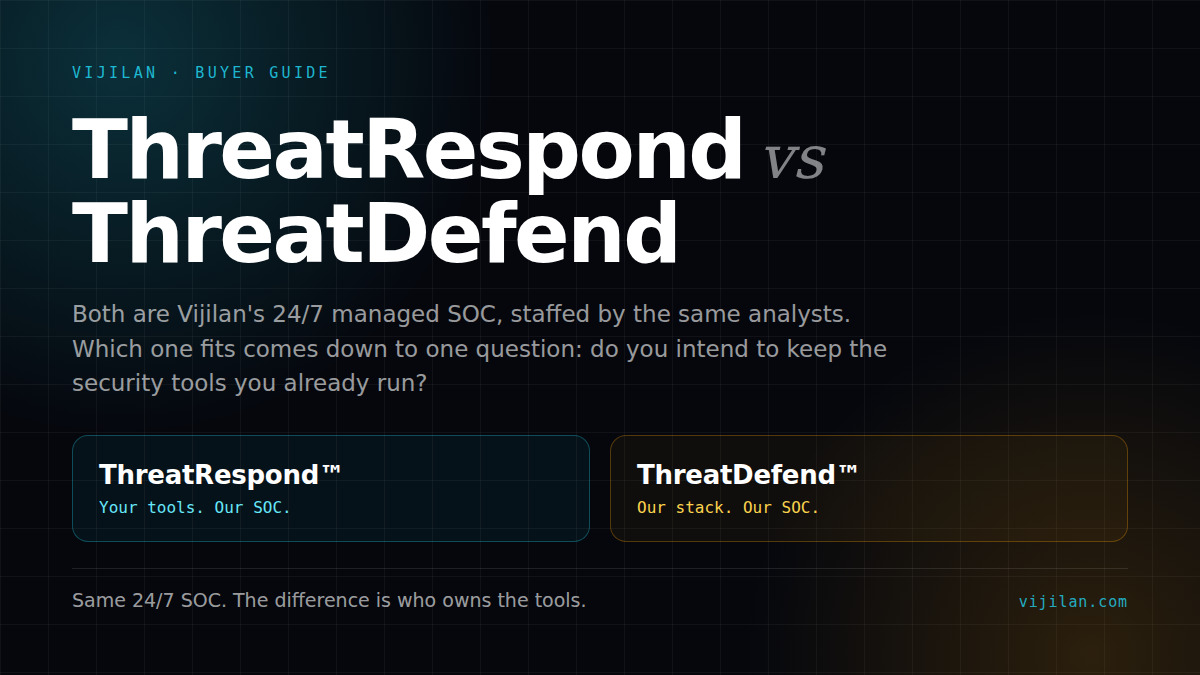
The first is SOC support for customer-owned or MSSP-managed tools. This works well for providers with an existing security stack, established workflows, and customers that need flexibility. In this model, the SOC team becomes the operational force behind your current architecture. It strengthens monitoring and response without forcing a platform replacement.
The second is a combined security stack and SOC model. This is often attractive for MSSPs that want faster deployment, stronger standardization, and cleaner operational control across customers. The value is simplicity. The trade-off is less tool variation, which may or may not fit your customer base.
A managed cybersecurity company like Vijilan addresses both paths through service models that either support the customer-owned stack or provide both the stack and the 24/7 SOC capability. For MSSPs, that flexibility is significant. It means you can align the operating model to your business instead of bending your business around a fixed service design.
What better execution looks like
When soc as a service for mssp organizations is working the way it should, a few things become visible quickly. Alert fatigue drops because triage quality improves. Incident investigations become more disciplined. Sales conversations become easier because your team can speak confidently about always-on coverage and response readiness.
Just as important, your internal staff can focus on higher-value work. Instead of spending nights buried in alert noise, they can spend more time on customer strategy, onboarding quality, architecture decisions, and service improvement. That is not just an efficiency gain. It is a maturity gain.
The strongest MSSPs are not trying to prove they can do every security function alone. They are building an operating model that stays credible under pressure, at scale, and after hours. That is the standard customers actually buy against.
If you are evaluating your next stage of growth, look at your overnight coverage, your investigation quality, and your ability to absorb new business without degrading response. Those pressure points usually tell you whether your SOC model is ready for the market you want to serve.
Threat notes, once a week
What our SOC actually saw this week: new attack patterns, the detections we shipped against them, and what it means if you run an MSP. Written by the analysts, not by marketing.
See what 24/7 looks like when the SOC actually acts.
Book a 20-minute platform walkthrough: no slide deck, just the console.
Book a walkthrough →