What AI Driven mXDR Services Actually Do
Learn how ai driven mxdr services improve 24/7 threat detection, investigation, and response for MSPs, SMBs, and enterprise security teams.

At 2:13 a.m., an endpoint starts beaconing to an unfamiliar domain, a user account attempts lateral movement, and a cloud workload shows a privilege change that does not match policy. That is not three separate problems. It is one attack path unfolding across multiple control points. AI driven mXDR services are built for exactly this kind of reality - where speed, correlation, and action matter more than isolated alerts.
For MSPs, MSSPs, VARs, and internal IT leaders, the question is no longer whether extended detection and response has value. The real question is whether the service can operate at production speed, across the tools you already use, with analysts who can investigate and act when something is wrong. That is where many offerings separate marketing from operations.
Why AI driven mXDR services matter now
Threat activity has changed faster than most security teams can staff for. Adversaries move across identity, endpoint, network, and cloud layers in minutes. They use legitimate tools, stolen credentials, and low-noise techniques that do not always trigger a single high-confidence alert on their own.
That creates a structural problem for lean IT and security teams. A traditional stack may generate telemetry from EDR, SIEM, firewalls, Microsoft 365, and cloud platforms, but raw visibility is not the same as managed defense. Someone still has to correlate the signals, determine whether they represent a real incident, and take the next step.
AI helps with the scale problem. It can cluster activity, surface anomalies, reduce repetitive analyst workload, and improve prioritization. But AI alone does not close incidents, contain hosts, or call a customer at 3:00 a.m. High-value mXDR combines machine-speed analytics with a live SOC that investigates and responds.
That distinction matters for both channel partners and end customers. Partners need a service they can confidently deliver under their own brand without exposing gaps in coverage. Businesses need evidence that the provider is not just watching dashboards but operating an actual response capability.
What AI driven mXDR services should include
The strongest AI driven mXDR services are not defined by one model or one tool. They are defined by an operating model. At minimum, that means 24/7 monitoring, telemetry correlation across security layers, triage by trained analysts, incident investigation, and response actions that align to the customer environment.
In practice, the service should ingest and interpret data from the controls that matter most to real attacks: endpoint activity, identity events, network signals, cloud workloads, email telemetry, and administrative behavior. AI can accelerate pattern recognition across those sources, but the output has to be operationally useful. If the result is just a faster stream of alerts, the service has not solved the customer’s problem.
A mature mXDR operation also needs a clear response model. Some customers want analyst-guided action and approval workflows. Others need direct containment authority for high-confidence threats. Neither model is universally right. The right choice depends on internal staffing, compliance posture, and risk tolerance.
For channel providers, flexibility is just as important as detection quality. Some clients already own significant parts of the security stack and want expert SOC coverage around those investments. Others want a more complete managed service that includes the security technology and the operations team behind it. A provider that supports both paths is easier to scale across a varied customer base.
AI is valuable, but human response is still the control point
There is a tendency in the market to talk about AI as if it replaces the analyst. In active security operations, that is the wrong frame. AI improves the SOC by accelerating what humans can validate, investigate, and act on. It does not eliminate the need for judgment.
Consider a suspicious PowerShell event tied to a service account. AI may correctly flag the command sequence as unusual. It may even connect it to an endpoint detection event and a failed identity challenge. But someone still has to determine whether the activity reflects maintenance, misconfiguration, or compromise. Someone has to assess blast radius, confirm persistence, and decide whether containment will disrupt a critical business function.
This is why response discipline matters more than AI claims. The service needs analysts who understand attacker behavior, customer environments, and escalation paths. It needs process maturity, not just model accuracy.
What buyers should evaluate before choosing a provider
The first area to examine is coverage depth. Ask whether the service truly monitors across endpoint, cloud, identity, email, and network, or whether it mainly extends one control category. Many providers use broad language around XDR while delivering narrow visibility.
Next is the response workflow. A 24/7 SOC is only meaningful if it can move from alert to investigation to action without friction. Buyers should ask who performs the investigation, what gets escalated, what can be contained, and how after-hours incidents are handled. If the answer is vague, the operational model may be immature.
Tool strategy also matters. Some organizations want a provider that can support their existing investments. Others prefer a tightly integrated service where the provider delivers both the platform and the SOC. There are trade-offs. Supporting customer-owned tools can preserve prior spend and reduce migration friction, but it may introduce variability across environments. A bundled stack can simplify operations and improve consistency, but it may require standardization that not every client is ready for.
For channel organizations, white-label execution deserves serious attention. If you plan to sell managed security under your own brand, the back-end provider must be able to deliver with discipline, discretion, and partner alignment. That includes escalation handling, reporting quality, and customer experience standards that reflect well on your business, not just theirs.
The operational models that fit different buyers
There is no single deployment model that works for every organization. That is especially true across MSPs, SMBs, and enterprises.
An MSP serving small and midsized clients often needs speed to market, recurring revenue, and a service that does not require building an internal SOC. In that case, white-labeled mXDR with a defined support model is usually the practical path. It gives the partner enterprise-grade security operations without the hiring burden, tooling complexity, or 24/7 staffing requirement.
A mid-sized business with an existing security stack may need a different model. If it has already invested in endpoint, SIEM, or identity tools, it may benefit more from a managed SOC service that wraps expert monitoring and response around those controls. The value there is operational maturity, not replacing technology for its own sake.
Enterprise buyers are often balancing scale, control, and governance. Some want a co-managed approach with specific integrations, formal escalation paths, and policy alignment across multiple teams. In those environments, the best provider is usually the one that can adapt to established processes without slowing response.
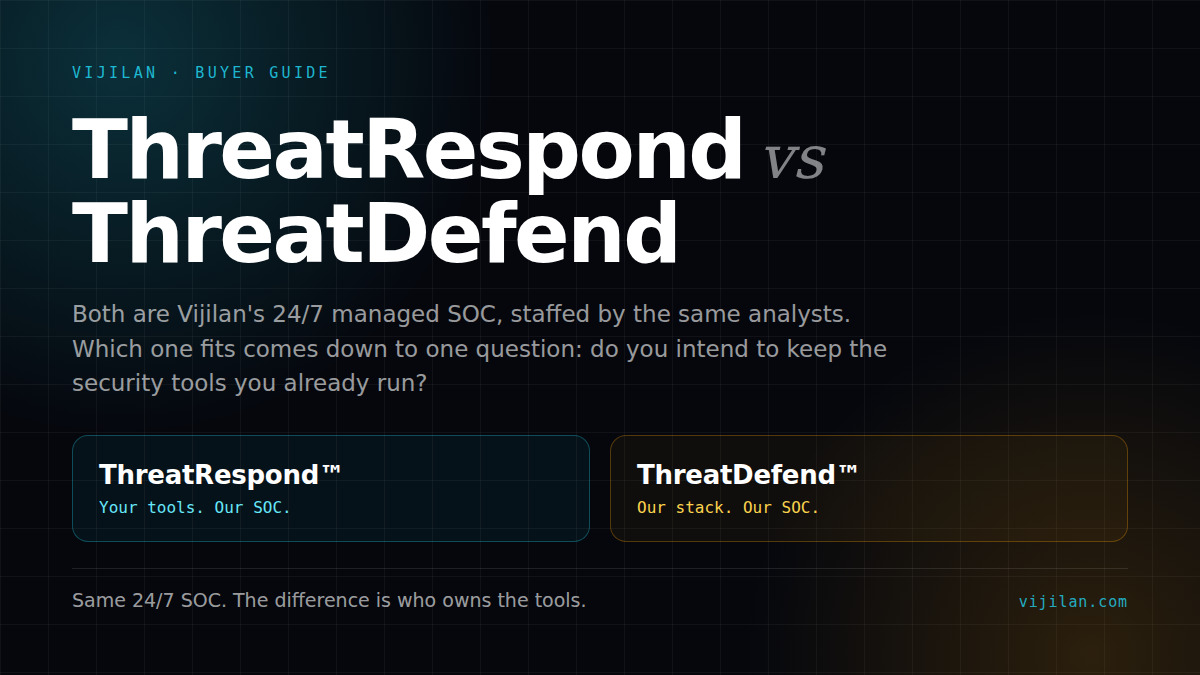
Vijilan addresses these realities with two service paths: ThreatRespond for customers that want SOC expertise around their own security tools, and ThreatDefend for organizations that want the security stack and SOC delivered together through CrowdStrike Falcon. That split reflects a practical truth in mXDR - customers do not all start from the same place, and forcing one model onto every environment creates friction where there should be coverage.
Where AI driven mXDR services create the most value
The greatest value appears where alert volume, attack surface, and staffing constraints intersect. That is why these services resonate so strongly with both channel partners and businesses that need around-the-clock coverage.
For partners, the gain is not just cybersecurity capability. It is service expansion without having to stand up a full SOC. That means faster entry into managed security, stronger retention, and more credible conversations with clients that are asking for real response, not just tools.
For end-user organizations, the value is operational. AI-supported detection can shorten time to identify suspicious activity. A live SOC can validate what matters, cut noise, and respond before a low-level event becomes an outage, fraud event, or ransomware incident. The benefit is not theoretical. It shows up in fewer missed signals, faster escalation, and tighter control over incidents that develop outside business hours.
The trade-off is that buyers need to be clear about expectations. A premium mXDR service is not a generic add-on. It works best when onboarding is thorough, response authority is defined, and integrations are aligned to the customer environment. When those conditions are in place, the service becomes part of the security operation, not a detached monitoring layer.
The market will keep adding AI claims. The more useful question is simpler: when a real threat appears, who sees it, who investigates it, and who acts? If the answer includes 24/7 coverage, cross-layer visibility, and analysts with the authority to respond, you are looking at a service that can hold the line when it counts.
Threat notes, once a week
What our SOC actually saw this week: new attack patterns, the detections we shipped against them, and what it means if you run an MSP. Written by the analysts, not by marketing.
See what 24/7 looks like when the SOC actually acts.
Book a 20-minute platform walkthrough: no slide deck, just the console.
Book a walkthrough →