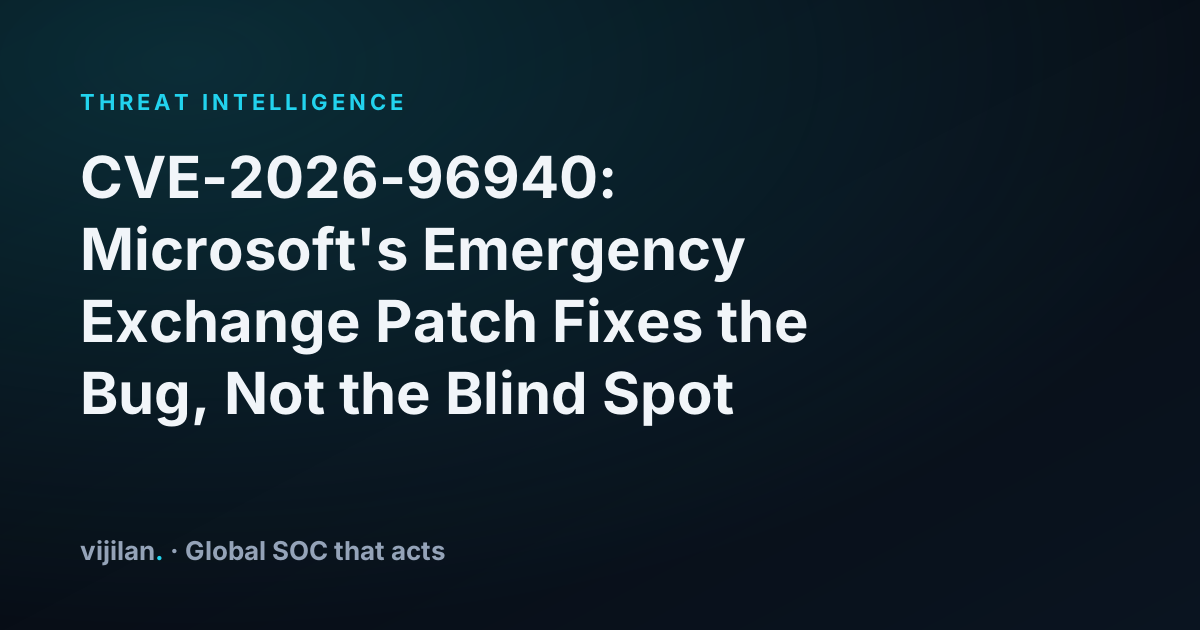
CVE-2026-96940: Microsoft's Emergency Exchange Patch Fixes the Bug, Not the Blind Spot
Microsoft shipped an emergency fix for CVE-2026-96940, a critical Exchange flaw that let authenticated users read mailboxes they had no business touching. Patching closes the door. It doesn't tell you who already walked through it.
What happened
Microsoft shipped an out-of-cycle security update this week for CVE-2026-96940, a critical Exchange Server vulnerability that lets an authenticated user escalate privilege and read mailbox content they don't own, no owner permission required [1][2]. The update landed as part of a new Exchange Server V2 security release [6][9][13], and Microsoft is telling admins in no uncertain terms to patch immediately rather than wait for the next maintenance window [4].
The affected population centers on on-premises Exchange Server, with reporting specifically calling out Exchange Server 2016 Cumulative Update builds [5]. If you run hybrid Exchange, Exchange Server standalone, or you manage Exchange for clients who insisted on keeping mail on-prem for compliance reasons, this is addressed to you.
The mechanics are almost boring to describe, which is exactly what makes them dangerous. A valid, authenticated session, the kind your help desk issues every day, gets treated as sufficient proof that the user should be able to open any mailbox on the server, not just their own [7]. One piece of coverage put it well: the vulnerability confuses having a key with being allowed to open every door in the building [10]. That's not a metaphor for attackers breaking in. It's a description of what a legitimate, logged-in account could already do before the patch existed.
Why "we patched it" is an incomplete sentence
Here's the part that should bother every MSP reading this more than the CVE number does: patching CVE-2026-96940 stops new exploitation. It says absolutely nothing about whether a credential that was compromised last week, last month, or last quarter already used this flaw to read mail in other mailboxes before the fix shipped.
Think about what that means in practice. If an attacker phished a mailbox clerk's credentials in October, logged in through normal, unremarkable authentication, and then quietly pulled messages out of the CFO's mailbox, finance's mailbox, and legal's mailbox, none of that required malware. None of it tripped an EDR alert. It looked like a user reading mail, because technically, it was a user reading mail. The vulnerability isn't in the login. It's in what the login was allowed to touch next.
That's the gap between "we applied the patch" and "we know what happened before the patch." Closing the first without investigating the second means you've fixed the vulnerability and left the question open.
What a partner should actually do this week
Patching is necessary and not optional, but it's step one of three, not the whole job.
- Apply the Exchange Server V2 update now, on every affected on-prem and hybrid server, not just the ones flagged as internet-facing [6][9]. If you manage Exchange for multiple clients, this is a fleet-wide push, not a case-by-case judgment call.
- Confirm mailbox audit logging is actually enabled and retained. Exchange Server and Microsoft 365 both support mailbox audit logging that records non-owner access events, meaning any time someone other than the mailbox owner opens, reads, or moves a message [14][15]. A lot of on-prem Exchange environments have this switched off by default or set to a retention window too short to matter. If it's off, you have no record of what happened before you patched, and no way to answer the question a client is going to ask you.
- Run a non-owner mailbox access report across the environment, specifically looking for cross-mailbox reads that don't map to a delegated permission, a shared mailbox arrangement, or an admin task someone can account for [16][17]. Exchange and Microsoft 365 both expose this through PowerShell and the compliance tooling [19][20], and it's worth running even if you're confident nothing happened. Confident and verified are different things.
- Treat any unexplained non-owner access as a credential incident, not an audit footnote. If a service account or user mailbox shows access patterns that don't fit its normal role, that's a live investigation, not a line item to revisit next quarter.
For partners managing this across a client base, the honest answer is that step 3 doesn't scale as a manual Friday-afternoon PowerShell exercise once you're past a handful of tenants. Somebody has to actually look at the logs, correlate the anomalies against who's supposed to have access to what, and act on what they find, fast enough that it matters.
Where Vijilan fits
This is the exact shape of gap our Global SOC is built to close. Once mailbox audit logging is enabled and feeding into monitoring, our analysts hunt Exchange mailbox audit logs for cross-mailbox access anomalies, the pattern where a credential starts reading mail outside its normal lane, whether that's a compromised account riding this CVE or an insider poking around somewhere they shouldn't be. That hunt isn't a quarterly report. It runs as part of ongoing monitoring under ThreatRespond™, our Managed XDR service, alongside identity telemetry from Microsoft Defender, Entra, and Sentinel where those are already in the stack.
And when something turns up, the SOC doesn't file a ticket and wait for someone on your team to close it during business hours. Containment actions, session revocation and account lockout among them, happen as part of the response, so a compromised credential stops being useful the moment the pattern is confirmed, not whenever the ticket queue gets to it.
For MSPs and MSSPs, that's the difference between telling a client "we patched Exchange" and telling them "we patched Exchange, and we confirmed nothing abnormal touched your mailboxes before or after." One of those answers closes the conversation. The other one is the sentence your client actually wanted to hear, and we never compete with our partners for their clients when we're the ones delivering it under your name.
If you're white-labeling SOC coverage already, this is a conversation to have with clients running Exchange this week, not next quarter. If you're not yet, now's a reasonable time to ask what your current monitoring would have caught here, and what it wouldn't have.
Questions about fitting mailbox audit hunting into your existing stack or a white-label engagement, visit our MSP page. For anything involving numbers, that conversation lives at pricing, not here.
Frequently asked questions
What is CVE-2026-96940?
CVE-2026-96940 is a critical Microsoft Exchange Server vulnerability that allows an authenticated user to escalate privilege and read mailbox content belonging to other users without owner permission. Microsoft shipped an emergency security update to fix it.
Which Exchange versions are affected by CVE-2026-96940?
Reporting on the flaw specifically identifies on-premises Exchange Server, including Exchange Server 2016 Cumulative Update builds, as affected. Hybrid Exchange deployments should also be checked and patched.
Does patching CVE-2026-96940 confirm nothing was accessed before the fix?
No. Patching stops new exploitation but does not reveal whether a compromised credential used the flaw to access other mailboxes before the patch was applied. That requires reviewing mailbox audit logs for non-owner access.
How can an organization check for past unauthorized mailbox access?
Exchange Server and Microsoft 365 support mailbox audit logging, which records non-owner access events. Running a non-owner mailbox access report, via PowerShell or compliance tooling, surfaces whether any accounts accessed mailboxes they shouldn't have.
How does Vijilan help with vulnerabilities like CVE-2026-96940?
Vijilan's Global SOC hunts Exchange mailbox audit logs for cross-mailbox access anomalies tied to credential compromise, and can take containment action such as session revocation or account lockout as part of ThreatRespond, our Managed XDR service, rather than waiting on ticket resolution.
Threat notes, once a week
What our SOC actually saw this week: new attack patterns, the detections we shipped against them, and what it means if you run an MSP. Written by the analysts, not by marketing.
See what 24/7 looks like when the SOC actually acts.
Book a 20-minute platform walkthrough: no slide deck, just the console.
Book a walkthrough →