CrowdStrike's SafeMind Pits AI Against AI. Here's What a CISO Should Actually Do With That
CrowdStrike's SafeMind runs offensive and defensive AI models against each other inside Falcon. We break down what that buys a CISO, and why the fight still needs a referee.
The Pitch: Let Your AI Fight Your Attacker's AI
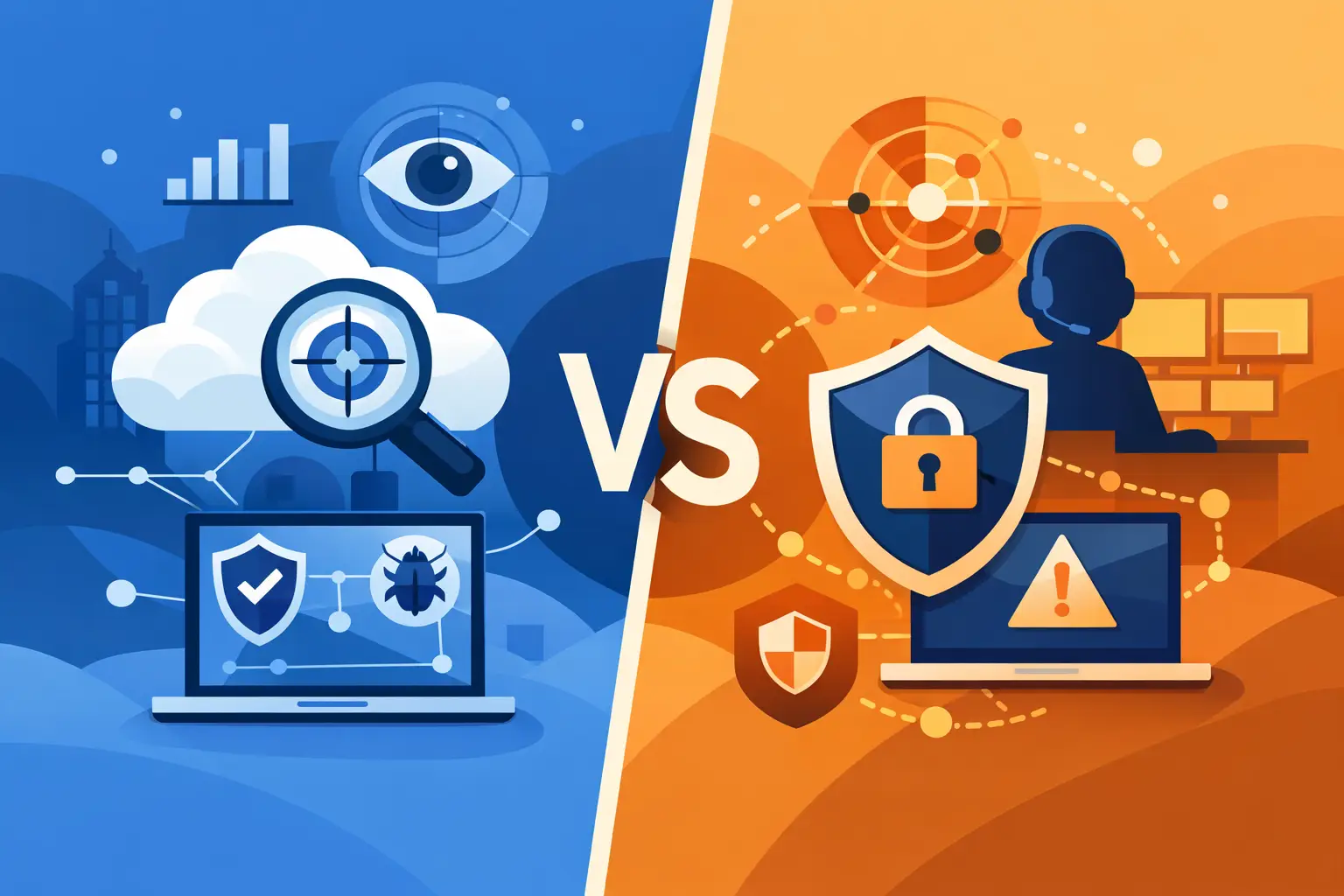
CrowdStrike has a new idea, and it is a genuinely interesting one. At its recent event, the company launched SafeMind, an agentic cybersecurity system built with NVIDIA, that puts two specialized AI models in the ring together, one playing offense and one playing defense, and lets them iterate against each other at machine speed [1][3]. The offensive model probes, the defensive model responds, and the loop repeats faster than any human red team versus blue team exercise ever could [16].
This came out of CrowdStrike's new Cyber Superintelligence Lab, developed alongside NVIDIA using Nemotron frontier models, and it is explicitly framed as 'fight fire with fire' [2][3][5][6]. CrowdStrike also expanded its AI security suite with Falcon Guardian around the same announcement, signaling this is not a one-off demo but a direction [14].
If you run a Falcon environment, or you are evaluating one, you need to understand what this actually is before your board asks you about it. Spoiler: it is not a SOC replacement. It is a very fast sparring partner.
What SafeMind Actually Does
Strip away the keynote language and SafeMind is an adversarial training loop. One AI model is tuned to behave like an attacker, generating techniques and probing for weaknesses. The other is tuned to detect and respond to exactly that behavior. They run against each other continuously, and the defensive side gets sharper because it is being tested by something that never gets tired, never follows a script, and never needs a lunch break [3][16].
That is a legitimate advance in how detection logic gets refined. Traditional purple-teaming is valuable but expensive and infrequent, usually a quarterly exercise with a human red team and a report nobody reads until the renewal meeting. An AI-versus-AI loop can run continuously, surfacing gaps in detection coverage at a pace no calendar-based engagement can match.
It is worth being precise about what this is not. SafeMind is not an autonomous incident responder making containment decisions on your production network. It is a model-training and model-testing system that sharpens the defensive AI's instincts before that AI ever touches your environment. The distinction matters, because the coverage reports about this launch have been careful to call it dual-use technology, and dual-use cuts both ways [13].
The Part the Headlines Skip: Dual-Use Means Dual-Risk
An AI model good enough to simulate a competent attacker is, definitionally, a model good enough to behave like one. Coverage of the SafeMind launch has flagged exactly this tension, that building an offensive AI capable of meaningfully testing your defenses means building offensive AI, full stop [13]. CrowdStrike's own framing leans into this directly, treating adversarial AI-on-AI testing as the new baseline for defense rather than a controlled research exercise kept at arm's length [17].
This is not a knock on CrowdStrike. Every credible frontier security lab is wrestling with the same problem right now: you cannot build a defensive AI that understands attacker behavior without building something that understands attacker behavior. The question for a CISO is not whether vendors should build these systems. They will, because attackers already have access to equivalent capability. The question is who is accountable for the output when the agentic loop makes a call, and what sits between that model's recommendation and your production environment.
Where Human Judgment Still Has to Sit
Agentic AI that tests itself against adversarial AI produces one thing extremely well: faster-tuned detection logic. It does not produce organizational context. It does not know that your finance team's unusual login pattern last Tuesday was a legitimate quarter-close process, not lateral movement. It does not know which of your business units just went through an acquisition and inherited a pile of unmanaged assets. It does not know your tolerance for a false positive that locks out a VP during a board call.
That is the layer a Global SOC exists to provide, and it is exactly why Vijilan builds ThreatRespond™, our Managed XDR service, around human analysts who triage and validate what the AI surfaces rather than letting the model act unsupervised. When a vendor's AI gets faster at spotting anomalies, the value of a human who can tell a real anomaly from a noisy one does not shrink. It grows, because the volume of signal the AI produces grows too, and someone still has to decide what gets escalated and what gets closed.
We watch this dynamic play out constantly across platforms we ingest from, Falcon included alongside Microsoft Defender, Sentinel, and SentinelOne telemetry. The pattern holds regardless of vendor: better detection models mean more candidate alerts, not fewer decisions. ThreatHunt™ and ThreatAssess™ exist specifically to put analyst judgment on top of that growing signal volume, so the agentic layer makes your defenses sharper without making your decision-making automatic.
What This Means If You Run Falcon
If your environment is built on CrowdStrike Falcon, SafeMind and the broader Cyber Superintelligence Lab work are good news. The detection logic your EDR relies on is being stress-tested against adversarial AI continuously, and that should translate into better baseline coverage over time. Vijilan holds CrowdStrike Powered Service Provider status, which is a partner-program designation reflecting our operational depth on the Falcon platform, and our Global SOC ingests Falcon telemetry directly into ThreatRespond and ThreatDefend™ so that improvements on CrowdStrike's side show up in what our analysts see, without you having to re-architect anything.
The takeaway for a CISO evaluating this announcement is straightforward. Ask your vendor, any vendor, what sits between the AI's recommendation and an action in your environment. If the answer is 'the model decides,' ask for the governance detail. If the answer involves a human SOC validating before containment, you are looking at the model being used the way it should be, as a force multiplier for people, not a replacement for them.
Watch the Replay: Who's Accountable at Machine Speed?
The question running through this post, who answers for what an AI does, is the one we took live. On October 8, 2026, Vijilan hosted a panel, "Who's Accountable at Machine Speed?", moderated by Kevin Nejad, Chief Executive Officer of Vijilan, on where AI ends and human judgment has to begin. The replay is free and needs no registration.
It covers a working autonomy model (observe, enrich, recommend, act), a test for sorting reversible automated actions from the ones that need a person, and the questions to put to anyone selling you an autonomous SOC. Watch the replay.
The Honest Bottom Line
AI sparring with AI to find gaps faster is a genuine step forward in how detection gets tuned. It is not a step forward in accountability, context, or judgment, and no vendor announcement has claimed otherwise, whatever the keynote slide implied. Faster-tuned detection paired with a Global SOC that validates and contains is a stronger posture than either piece alone. Faster-tuned detection with nobody watching the output is just a more confident alarm system.
If you want to talk through how ThreatRespond layers onto a Falcon environment, or what co-managed coverage looks like against this kind of platform evolution, reach out through our MSP page if you're evaluating this through a partner lens, or get in touch directly. Questions about program cost belong at the pricing page.
Frequently asked questions
What is CrowdStrike SafeMind?
SafeMind is an agentic cybersecurity system CrowdStrike built with NVIDIA, using Nemotron frontier models, that runs an offensive AI model against a defensive AI model in a continuous adversarial loop to sharpen detection logic faster than traditional red team exercises.
Does SafeMind make SOC analysts unnecessary?
No. SafeMind tunes detection models through AI-versus-AI testing before deployment. It does not make containment decisions in a live environment or understand business context, which is why human validation through a managed SOC remains essential.
Is it risky to build offensive AI to test defensive AI?
Coverage of the launch has flagged this as a genuine dual-use tension, since an AI model capable of meaningfully simulating an attacker is, by definition, capable of attacker-level behavior. Governance over how that capability is contained matters as much as the capability itself.
How does this affect customers running CrowdStrike Falcon with Vijilan?
Vijilan holds CrowdStrike Powered Service Provider status and ingests Falcon telemetry directly into ThreatRespond and ThreatDefend. Improvements to Falcon's underlying detection models from initiatives like SafeMind flow into what our Global SOC analysts monitor, without requiring changes to your deployment.
Watch the panel replay on this topic: https://vijilan.com/webinar/machine-speed
Sources
- CrowdStrike Launches Frontier Models for Cybersecurity, Created with NVIDIA
- Cyber Superintelligence Lab: Agentic Cybersecurity
- CrowdStrike unveils SafeMind AI frontier models to let defenders fight fire with fire - Cyber Daily
- CrowdStrike Unveils SafeMind AI Cybersecurity System < IT·Gaming < 기사본문 - The Elec Inc.
- NVIDIA and CrowdStrike Strengthen Agentic Cybersecurity Frontier
- CrowdStrike Launches SafeMind Agentic AI Cybersecurity System Built With NVIDIA Nemotron
- CrowdStrike Launches SafeMind Frontier Cybersecurity Models Built With NVIDIA Nemotron
- CrowdStrike Launches SafeMind Agentic AI System for Cybersecurity With NVIDIA
- CrowdStrike Charlotte AI Models 2026: Agentic SOC Triage Guide - AI Learning Guides
- CrowdStrike and NVIDIA Launch Agentic Cyber-Defence Lab and SafeMind - CXO Digitalpulse
- CrowdStrike launches cyber frontier AI models, agentic security system
- CrowdStrike and Nvidia launch SafeMind AI cybersecurity system
- CrowdStrike and NVIDIA Launch Dual-Use Cybersecurity AI
- CrowdStrike expands AI security suite with Falcon Guardian, SafeMind (CRWD:NASDAQ)
- CrowdStrike launches SafeMind and cyber defence AI lab
- CrowdStrike's Red Team AI Loops With Blue Team AI at Machine Speed - DEV Community
- AI-based cyberattacks reshape cybersecurity - SiliconANGLE
- CrowdStrike SafeMind: Powerful AI Defense Against Threats
- CrowdStrike’s SafeMind puts red-team and blue-team AI inside Falcon
- CrowdStrike launches SafeMind AI models for cybersecurity defence
Threat notes, once a week
What our SOC actually saw this week: new attack patterns, the detections we shipped against them, and what it means if you run an MSP. Written by the analysts, not by marketing.
See what 24/7 looks like when the SOC actually acts.
Book a 20-minute platform walkthrough: no slide deck, just the console.
Book a walkthrough →