ThreatRespond vs ThreatDefend: Which Vijilan Managed SOC Service Fits
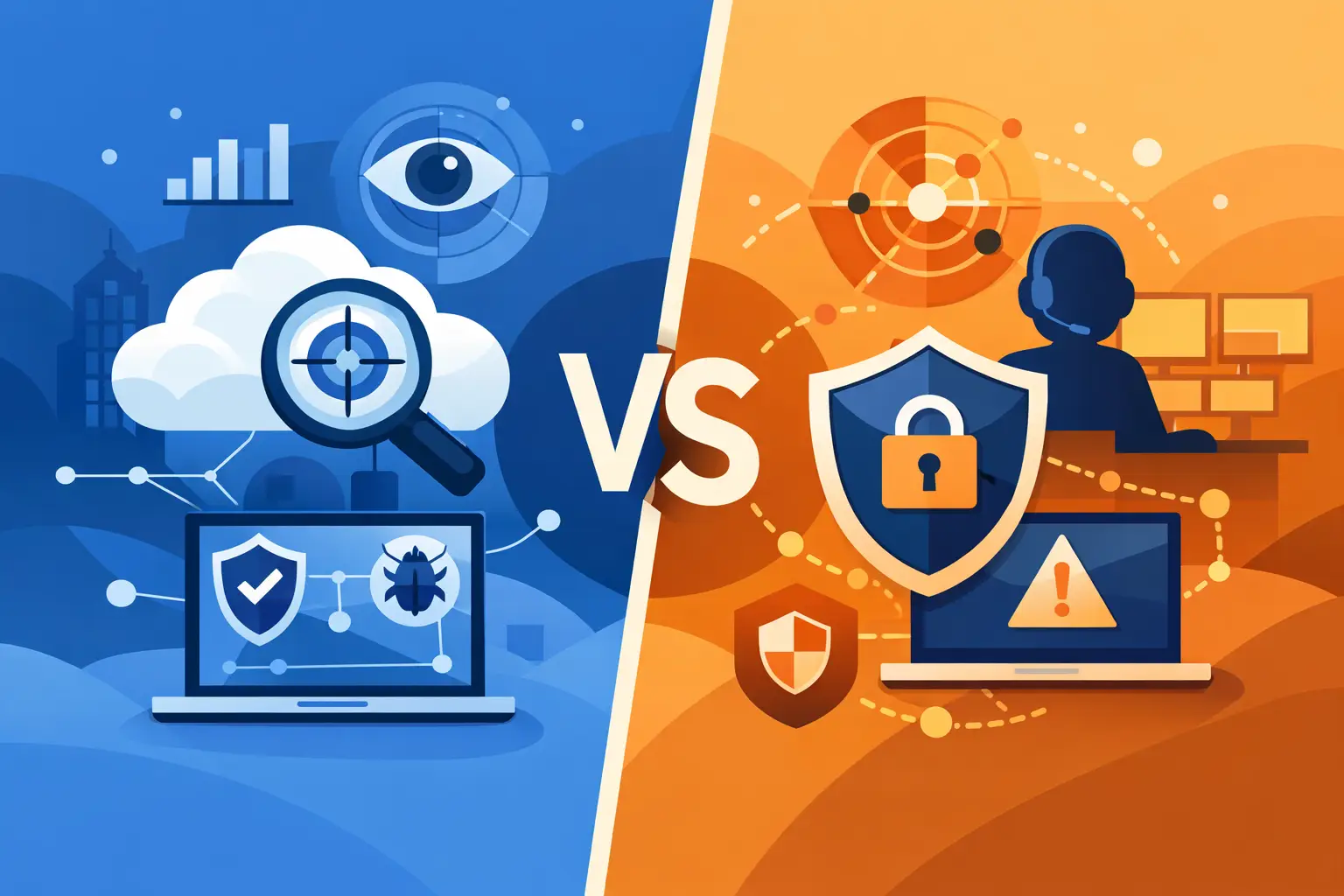
ThreatRespond and ThreatDefend are both 24/7 managed SOC services from Vijilan, run by the same analyst team. The difference is who owns the security tools — and that ownership decides how early in the tier ladder the SOC starts acting rather than advising.
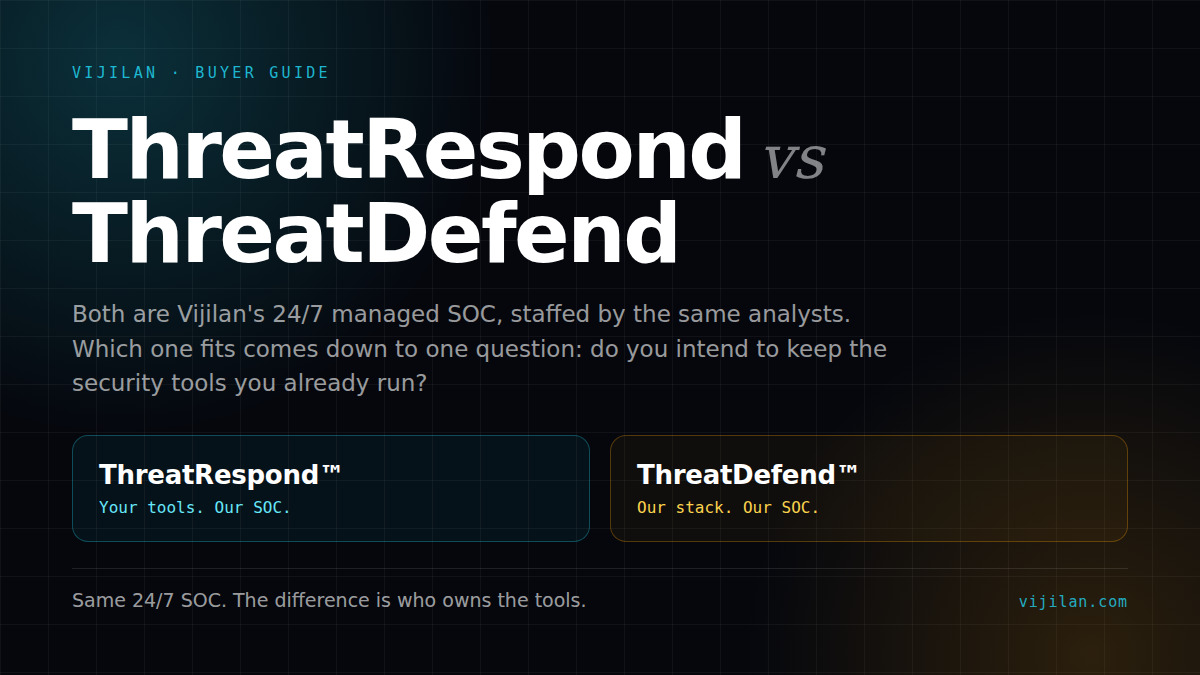
Short answer: ThreatRespond™ and ThreatDefend™ are both 24/7 managed SOC services from Vijilan, staffed by the same analysts and covering the same security domains. The difference is who owns the security tools — you do, or Vijilan does — and that ownership decides how early in the tier ladder the SOC starts acting rather than advising.
Last reviewed 22 August 2026.
What is ThreatRespond?
ThreatRespond is Vijilan's vendor-agnostic managed SOC service. It works with the security tools an organization has already standardized on — SentinelOne, Microsoft Defender, Carbon Black, Fortinet, Palo Alto Cortex XDR and others — rather than replacing them.
The SOC monitors those tools 24/7 across endpoint, identity, network, cloud, application and data. Tier 1 through Tier 3 analysts review every alert. Confirmed incidents come back with a guided remediation runbook, and priority alerts flow into your service desk through bi-directional PSA ticketing (ConnectWise, Autotask, Jira, Zendesk).
The buyer for ThreatRespond has already spent the money on tooling and does not want to spend it again. They are renting the expertise, not the software.
What is ThreatDefend?
ThreatDefend is Vijilan's fully managed service, where Vijilan brings the stack as well as the SOC. It runs on CrowdStrike Falcon EDR/XDR, deployed by Vijilan, with identity threat detection and response (ITDR) included from the entry tier.
It covers everything ThreatRespond does, and adds what follows from Vijilan owning the tooling: active containment — host isolation, account disable, token revoke, process kill — from the first tier up, and incident lifecycle ownership through to a forensics report.
The buyer for ThreatDefend wants the whole problem handled, including procurement of the tools.
What is the actual difference between them?
The SOC is the same. The coverage is the same. The difference is who owns the tools, and how early the SOC starts acting on them.
Both services run the same four tiers: Essential, Advanced, Premium and Elite. Where the SOC begins to contain incidents rather than hand over a runbook depends on which service you are on.
With ThreatDefend, Vijilan owns the stack, so the SOC contains from the Essential tier and at every tier above it. With ThreatRespond, the tools are yours, and the SOC acts on them from the Advanced tier — at Essential it investigates to a conclusion and hands your team a specific remediation runbook to execute.
That is a capability line, not a service-quality line. An organization with a capable internal IT team and a strong existing stack often gets more value from ThreatRespond. An organization whose realistic alternative is "the alert waits until Monday" needs the service that acts, at the tier where it acts.
| ThreatRespond | ThreatDefend | |
|---|---|---|
| The line | Your tools. Our SOC. | Our stack. Our SOC. |
| Who owns the security tools | You do | Vijilan does |
| Underlying stack | Vendor-agnostic — whatever you run | CrowdStrike Falcon, deployed by Vijilan |
| Monitoring coverage | Endpoint, identity, network, cloud, application, data | Same |
| Analyst tiers on every alert | Tier 1–3 | Tier 1–3 |
| SOC contains, not just advises | From the Advanced tier | From the Essential tier — all tiers |
| ITDR included | From Advanced | From Essential |
| Threat hunting | ThreatHunt™ | ThreatHunt |
| Rip-and-replace required | No | Yes, on endpoint and identity |
| Pricing basis | Per asset, volume discounts across the partner's book | Per asset, volume discounts across the partner's book |
| Best fit | An existing stack you intend to keep | You want the tooling and the operations handled together |
Which one should we choose?
Answer one question: do you intend to keep the security tools you have?
Choose ThreatRespond if:
- You have standardized on an EDR, firewall and IAM you are happy with, and replacing them is not on the table.
- You have internal IT or security staff who can execute a remediation runbook when handed one — or you are taking the Advanced tier or above, where the SOC acts on your tools directly.
- You are consolidating vendors on the services side rather than the tooling side.
- Contractual or regulatory constraints tie you to a specific security vendor.
Choose ThreatDefend if:
- You are buying or renewing EDR anyway, and would rather have it operated than own the operating problem.
- There is no one reliably available at 3am to act on an escalation, and you want containment included at the entry tier.
- You want a single accountable party for detection, containment and the post-incident report.
- You are already on CrowdStrike Falcon, or moving there.
Can one organization run both?
No — the rule is one product per environment. An environment runs ThreatRespond or ThreatDefend, never both at once, because the two services make opposite assumptions about who owns the endpoint agent.
Genuinely separate environments are scoped separately, which is how a single company can end up with both: an acquired business already running a different EDR can stay on ThreatRespond while the parent estate runs ThreatDefend, rather than forcing a migration on day one.
Can you switch from one to the other?
Yes, and ThreatRespond to ThreatDefend is the common direction. Organizations frequently start with ThreatRespond because it requires no procurement cycle and no agent replacement, then move to ThreatDefend at their next EDR renewal, when the tooling decision is open anyway.
The reverse happens too, usually after an acquisition brings in an estate that is not worth migrating.
Who decides when the SOC acts?
A human does, on both services. The escalation path is the same either way, and an analyst reviews every alert before it reaches you. Automation is what removes latency from triage; a Vijilan analyst authorizes consequential action. The SOC is never autonomous-only.
That is the part worth checking with any managed SOC provider, because it is where "AI-powered" claims and operational reality tend to diverge.
What if neither fits?
Neither is the right question if your problem is a CrowdStrike Falcon Next-Gen SIEM deployment that needs engineering and operating rather than an MDR tier. That is NextDefend™, delivered as Deploy · Sustain · Operate, and it sits on a different axis from these two: it is about ingest, parsing, detection content and remediation across the whole environment rather than a managed tier over an endpoint stack.
Frequently asked questions
Is ThreatRespond just alerting? No. Analysts investigate to a conclusion and hand over a specific remediation runbook, not a raw alert. From the Advanced tier the SOC also acts on your tools directly. The distinction from ThreatDefend is which tier containment starts at, not whether investigation happened.
When does the SOC start containing incidents? With ThreatDefend, from the Essential tier and every tier above it. With ThreatRespond, from the Advanced tier — because the tools belong to you, and acting on someone else's stack requires an approved runbook and access to it.
Does ThreatDefend require us to remove our current EDR? Yes, on endpoint and identity. ThreatDefend runs on CrowdStrike Falcon. If removing your EDR is not acceptable, ThreatRespond is the service that fits.
Do both cover more than endpoints? Yes. Both cover endpoint, identity, network, cloud, application and data. Endpoint-only MDR is a common category of competitor; neither Vijilan service is limited that way.
Can one client run both services at once? No. One product per environment. Separate environments are scoped separately, so a company with an acquired estate on a different EDR can run one service on each.
Can an organization buy these directly, or only through a partner? Both. Vijilan reaches customers through MSP and MSSP partners, through VARs and distributors, and directly for mid-market and enterprise buyers. Partners have a standing commitment that Vijilan never competes with them for their clients.
How does ThreatDefend relate to CrowdStrike Falcon Complete? They are complements, not substitutes. Falcon Complete responds on the endpoint. ThreatDefend is Vijilan's own 24/7 SOC operating Falcon as one accountable service across endpoint, identity, network, cloud, application and data. If the question is specifically about extending detection and containment past the endpoint agent on a Falcon Next-Gen SIEM deployment, that is NextDefend Operate rather than either service here.
What does it cost? Both are priced per asset per month: endpoints, users, servers and firewalls are each priced as assets, cloud and identity sources such as Microsoft 365 are priced per user, and volume discounts apply across a partner's whole book. Vijilan does not publish rates — /pricing is a short qualification step that routes you to verified pricing for your organization.
Who is Vijilan? A managed cybersecurity provider founded in 2014, headquartered in Hallandale Beach, Florida, operating a 24/7 SOC. ISO/IEC 27001 certified and independently audited to SOC 2 Type II annually. A CrowdStrike Powered Service Provider (CPSP). HIPAA, PCI and CMMC L2 evidence packs are available on request.
Next step
If you want the decision in table form, compare the two services side by side — that page is the decision tool, this one is the explanation.
If you would rather start from evidence than from a spec sheet, find out what an attacker already sees. ThreatAssess™ is a free external attack surface scan — give Vijilan a domain and it returns what is exposed and what would be shut down. No agent, no credit card.
Compare the two services · Run a free ThreatAssess scan · Talk to the SOC team
Threat notes, once a week
What our SOC actually saw this week: new attack patterns, the detections we shipped against them, and what it means if you run an MSP. Written by the analysts, not by marketing.
See what 24/7 looks like when the SOC actually acts.
Book a 20-minute platform walkthrough: no slide deck, just the console.
Book a walkthrough →